
CLASS 6531 I HUMAN CASE WEEK 9 66-YEAR-OLD WOMEN. REASON FOR ENCOUNTER BACK PAIN COMPLETE CASE STUDY WITH SCREENSHOTS.
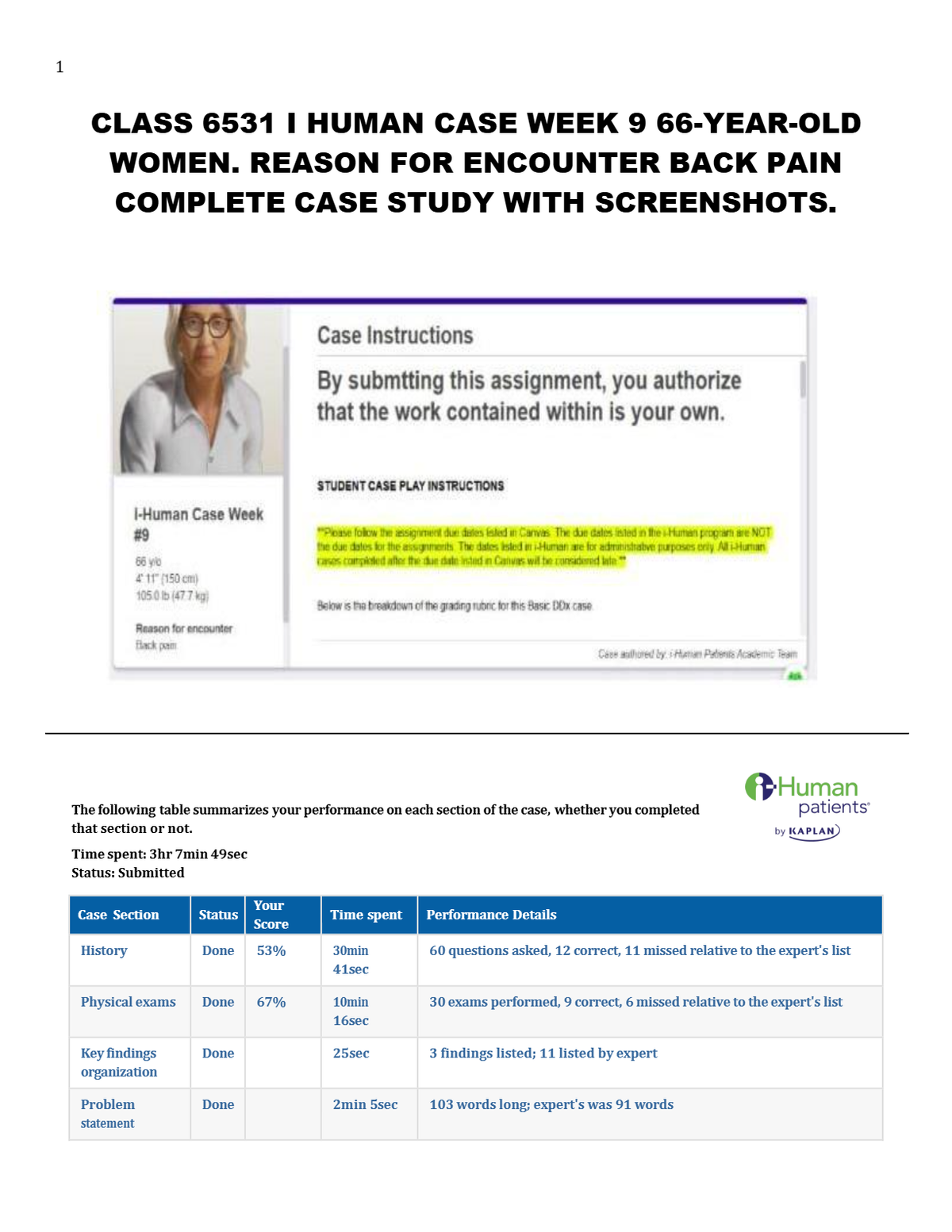
CLASS 6531 I HUMAN CASE WEEK 9 66-YEAR-OLD WOMEN. REASON FOR ENCOUNTER BACK PAIN COMPLETE CASE STUDY WITH SCREENSHOTS.
The following table summarizes your performance on each section of the case, whether you completed that section or not.
Time spent: 3hr 7min 49sec Status: Submitted
|
Case Section |
Status |
YourScore |
Time spent |
Performance Details |
|
History |
Done |
53% |
30min 41sec |
60 questions asked, 12 correct, 11
missed relative to the expert's list |
|
Physical exams |
Done |
67% |
10min 16sec |
30 exams performed, 9 correct, 6
missed relative to the expert's list |
|
Key findings organization |
Done |
25sec |
3 findings listed; 11 listed by
expert |
|
|
Problem statement |
Done |
2min 5sec |
103 words long; expert's was 91
words |
2
|
Body system classification |
Done |
25% |
33sec |
1 of 4 correctly picked plus 0
extras |
|
Differentials |
Done |
33% |
7min 8sec |
4 items in the DDx, 1 correct, 2
missed relative to the expert's list |
|
Differentials ranking |
Done |
100%(lead/alt score) 67%(must not
miss score) |
39sec |
|
|
Tests |
Done |
100% |
2min 10sec |
2 tests ordered, 2 correct, 0 missed
relative to the expert's list |
|
Diagnosis |
Done |
100% |
8sec |
|
|
Management plan |
Done |
47min 18sec |
1077 words long; expert's was 75
words |
|
|
Exercises |
Done |
80%(of scored items only) |
16min 30sec |
4 of 5 correct (of scored items
only) |
3
Use this worksheet to organize your thoughts before developing a differential diagnosis list.
1. Indicate key symptoms (Sx) you have identified from the history. Start with the patient's
reason(s) for the encounter and add additional symptoms obtained from further
questioning.
2. Characterize the attributes of each symptom using "OLDCARTS". Capture the details in the
appropriate column and row.
3. Review your findings and consider possible diagnoses that may correlate with these symptoms.
(Remember to consider the patient's age and risk factors.) Use your ideas to help guide your
physical examination in the next section of the case.
|
HPI |
Sx = |
Sx = |
Sx= |
Sx= |
Sx= |
Sx= |
|
Onset |
2 days ago |
2 days |
||||
|
Location |
low back |
right low back/ butt down to below
right knee |
||||
|
Duration |
constant |
constant |
||||
|
Characteristics |
sharp |
shooting |
||||
|
Aggravating |
moving, rolling, walking |
|||||
|
Relieving |
none |
none |
||||
|
Timing / Treatments |
constant, no treatments tried |
none |
||||
|
Severity |
7/10 |
A
4
66-year-old female presents to the office for ongoing back pain that started 2 days ago after moving heavy tables at work. The pain had a sudden onset and is described as 7/10, sharp, and constant. There are no relieving factors. Movement, walking, and rolling over in bed make the pain worse. The pain affects the patient's sleep, ability to walk, and ability range of motion. She has radiating pain that starts at the top of the right butt/ low back that shoots down the right leg below the knee that started at the same time as the low back pain and is constant.
5
iHuman Management Plan Template
Primary Diagnosis and ICD-10 code(s); Herniated Nucleus Pulposus K44
1. Therapeutic pharmacologic and non-pharmacologic modalities including any additional laboratory
or diagnostic testing you may need (5 points):
Initial treatment would include bed rest for 1-2 days to help relieve the pain. After 1-2 days of rest, the patient should avoid sitting for long periods, make slow and controlled movements when bending forward and lifting objects, and avoid movements that cause further pain. It is important for the patient to remain active and not continue on bed rest. Ice and heat application to the low back can help relieve some of the pain. Gentle massage and stretching can help reduce pain. The patient can consider getting an epidural steroid injection to the L4-L5 area to reduce inflammation and relieve pain shortterm (American Academy of Orthopedic Surgeons, n.d.). In addition, using proper posture and starting physical therapy as soon as possible can help the injury.
Order: Naproxen 500 mg PO q 12h (max 1,200 mg/day) Cyclobenzaprine 10 mg PO TID PRN (max 30mg/day)
Additional testing that could be done includes DEXA scan to reassess the patient’s bone density depending on when the initial test was done. The patient had a previous T score of -2.5 which is a diagnosis of osteoporosis. DEXA scan should be done to assess for worsening of the condition.
2. Social Determinants of Health (5 points):
The patient should be assessed for economic stability. She works as a waiter and likely has not been able to work due to her injury. Her job most likely does not provide health insurance options, so the patient should be asked about her current health insurance if any. It is important to consider the out-ofpocket costs for the patient before ordering additional testing. The referral should be sent to a doctor within the patient’s healthcare network, so she can receive affordable care. The patient made it to her appointment so, the patient has access to healthcare. It is important to assess how the patient is getting around if she can drive, and if she can walk to her appointments considering stairs or long distances (Social Determinants of Health, n.d.).
The patient should be educated on her health condition. She should be asked about continuing education opportunities and community education programs available to her. The local community should offer education on health screening and promote exercise and healthy eating. It would be appropriate to ask how she maintains a healthy weight. She should have access to exercise facilities or equipment and healthy foods. The neighborhood should have a grocery store close by with affordable fresh produce. You could ask the patient where the closest YMCA or public facility is (Social Determinants of Health, n.d.). There are many social determinants involved in a patient’s life that can improve their health.
6
3. Health Promotion (5 points):
The patient should continue with her yearly mammograms and bone density screenings every 4-8 years. As of 1 year ago, the patient was up to date with colonoscopy screening. Colonoscopy screening should be done every 10 years. This patient has a smoking history and should be screened for lung cancer. A low-dose CT scan of the lungs should be done every year to screen for lung cancer (United States Preventive Services Taskforce, n.d.).
The patient should limit alcohol intake, stop smoking, and continue taking vitamin d and calcium. The patient should continue the alendronate medication for osteoporosis. The patient should be educated on steroid use related to bone loss and osteoporosis. She occasionally uses prednisone for asthma exacerbations and could be prescribed another medication for acute exacerbations. ProAir HFA inhaled 2 puffs inhaled every 4-6hours as needed for asthma exacerbations could be ordered for the patient (Asthma and Allergy Foundation of America, n.d.). She would then be able to discontinue the steroid.
She should get her annual flu vaccine and COVID-19 vaccines and booster if desired.
4. Patient education (5 points):
The patient should be educated that herniated disc injuries are often early signs of degeneration. Herniated discs are more common in the lower back, and disc material degenerates naturally with age and can be injured upon exertion. It is important to teach the patient to rest for a day or two and then stay active. It is important for the patient to remain on their feet and not