
Fundamental Principles of Engineering Nanometrology 1st Edition By Richard Leach
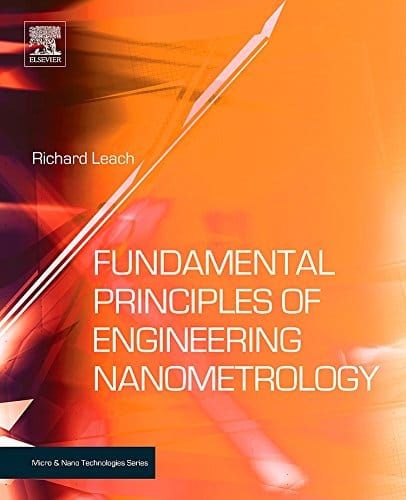
The 1st edition of the book Fundamental Principles of Engineering Nanometrology by Richard Leach was published by William Andrew in late 2009. It provides a comprehensive overview of engineering metrology as it relates to micro and nanotechnology research and manufacturing. Publication Details
- Author: Richard Leach
- Publisher: William Andrew (an imprint of Elsevier)
- Publication Date (Hardcover): October 9, 2009 (some sources list September 3, 2009, or November 2009)
- Print ISBN-13: 978-0080964546
- Print ISBN-10: 0080964540
- eBook ISBN-13: 978-1437778328
- Format: eBook
- Print Length: 352 pages
Key Content & FeaturesThe book extends the principles of engineering metrology to the micro- and nanoscale, focusing on dimensional and mass metrology, and serves as a reference for professionals and a textbook for students.
- Introduction to Measurement: Covers basic measurement terminology, SI units, and the highly important topic of measurement uncertainty.
- Precision Instrumentation: Discusses principles for precision instrument design, including kinematic design, the Abbe principle, and vibration isolation.
- Measurement Techniques: Presents numerous measurement techniques, from static length and displacement to surface topography, mass, and force.
- Instruments & Calibration: Covers multiple optical surface measuring instruments (interferometry, triangulation, etc.) and scanning probe microscopes, explaining their design, principles, and calibration in depth.
- Traceability: Details how length traceability is achieved using interferometry, including gauge block interferometry.
User and Expert OpinionsReviewers and experts regard the 1st edition of this book very highly for its comprehensive and practical approach.
- Comprehensive Guide: According to multiple reviewers on Amazon UK, it's considered an excellent guide and a superb text on micro- and nano-scale metrology that covers a wide range of fundamental and advanced techniques.
- Accessible Language: Experts and users noted that the book "seems to get the right balance" between simplifying problems and going into too much mathematical detail, making it comprehensible even to those with limited mathematical knowledge.
- Practical Value: It is described as a great textbook for students and researchers, offering a "routemap and toolkit for metrologists" engaging with the rigor of measurement at the nano-scale.