
Gravity and Magnetic Exploration: Principles, Practices, and Applications 1st Edition by William J. Hinze, Ralph R. B. von Frese, Afif H. Saad
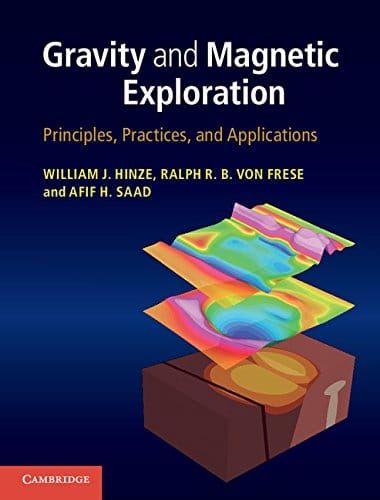
"Gravity and Magnetic Exploration: Principles, Practices, and Applications" is a comprehensive geophysical textbook and reference manual authored by William J. Hinze, Ralph R. B. von Frese, and Afif H. Saad. Published by Cambridge University Press, it is a standard resource for interpreting subsurface anomalies using potential field data.
Core Principles
- Physical Properties: The gravity method focuses on density variations in Earth materials, while magnetic methods target magnetic susceptibility.
- Anomaly Detection: Both methods measure spatial variations (anomalies) in Earth's fields to infer the presence of subsurface geological structures or materials.
- Integrated Modeling: Modern practice emphasizes combined strategies, using both gravity and magnetic fields together to reduce ambiguity in subsurface modeling.
Practices
- Data Acquisition: Covers measurements from diverse platforms, including surface (terrestrial), marine, airborne, and satellite sensors.
- Processing and Inversion: Includes digital data analysis, noise reduction, and inversion techniques to convert field measurements into physical models of the lithosphere.
- Survey Planning: Addresses the organization of surveys and the management of errors, which are critical for effective interpretation.
Applications
- Energy and Mineral Exploration: Widely used as a cost-effective tool in petroleum and mineral prospecting to identify target areas before more expensive seismic or drilling operations.
- Engineering and Environmental: Employed for detecting subsurface cavities, bedrocks, and groundwater resources.
- Archaeology: Used to identify buried structures without excavation.
- Lithospheric Studies: Assists in investigating large-scale crustal and subcrustal planetary features.