
HESI 1 V1 and V2 Review – Health Assessment 1 – A+ Guaranteed Success with Verified Questions and Answers
For the 2026 HESI Health Assessment (V1 and V2), focus on clinical prioritization and the distinction between subjective and objective findings. Below is a high-yield summary of topics frequently tested in both versions: Core Assessment Concepts
- Subjective vs. Objective Data: Subjective data is what the patient says (e.g., "itching," pain 7/10). Objective data is what you observe or measure (e.g., blood pressure, "slurred speech," "crepitation" felt during palpation).
- Assessment Types:
- Screening: Large-scale or preventative checks (e.g., cholesterol checks at a health fair).
- Focused: Problem-oriented for a specific complaint (e.g., assessment of a "stooped" posture).
- Comprehensive: Detailed baseline (e.g., admission to a long-term care facility).
- Prioritization (ABC's): Life-threatening issues like "impaired gas exchange" are always the first priority over non-emergent problems like "risk for infection".
Key Clinical Findings & Tests
- Respiratory:
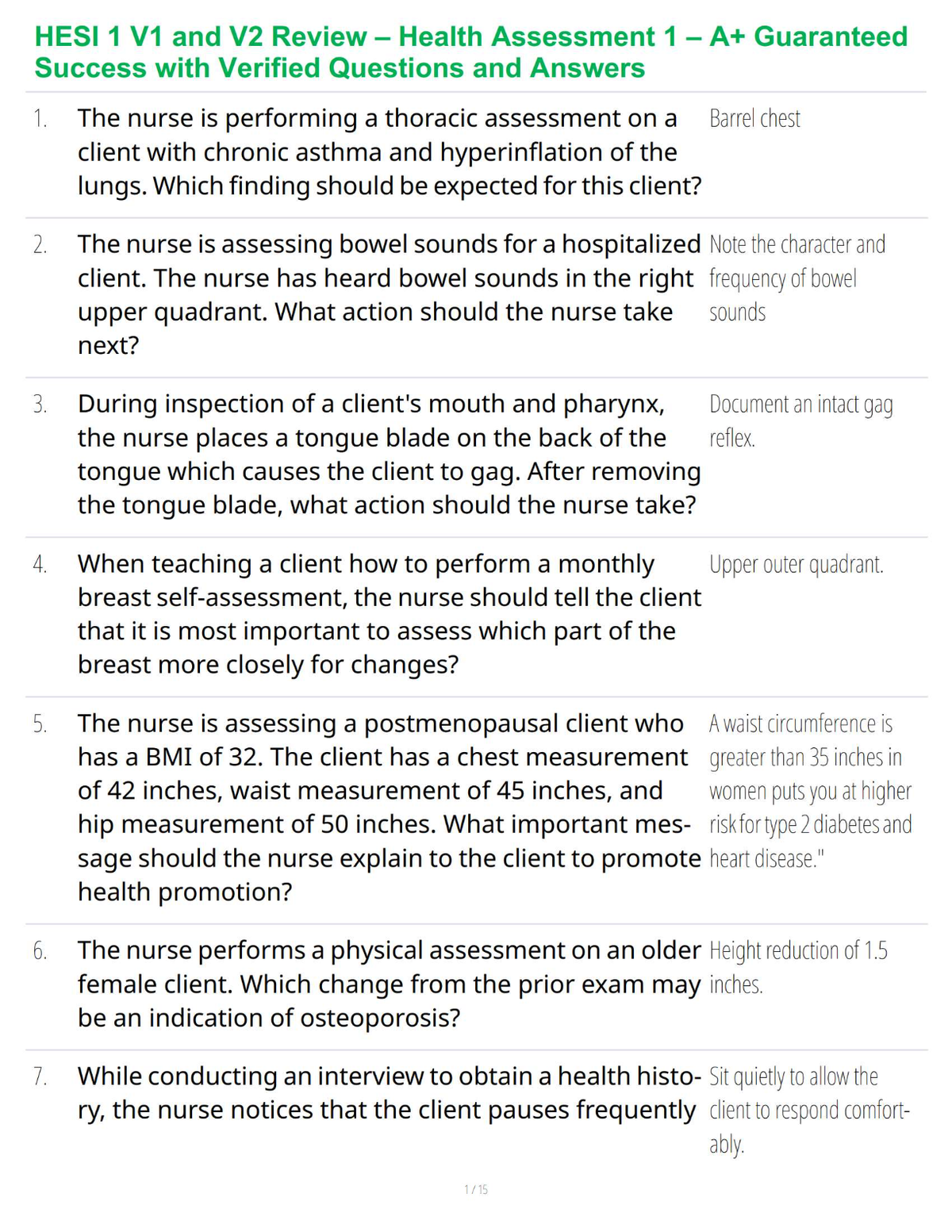
- Barrel Chest: Expected finding in chronic asthma or COPD due to lung hyperinflation.
- Bradypnea: Respiratory rate below 12 breaths/minute (e.g., 8 breaths/min).
- Neurological:
- Romberg Test: Assesses balance; patient must close their eyes.
- Cranial Nerve I (Olfactory): Assessed by identifying odors with one nostril occluded.
- Glasgow Coma Scale (GCS): Evaluates motor, verbal, and eye-opening responses.
- Cardiovascular & Integumentary:
- Petechiae: Small (1-3 mm), dark red lesions that do not blanch; may indicate bleeding disorders.
- Skin Turgor: Most accurately assessed on the anterior chest below the midclavicular area in adults.
- Pulse Deficit: Identified by comparing the apical pulse to the radial pulse.
Communication & History Taking
- CAGE Questionnaire: Used for alcohol abuse screening: Cut down, Annoyed, Guilty, Eye-opener.
- Interviewing Techniques: Use open-ended questions to allow the patient to choose their response. For patients who hesitate during an interview, sit quietly to allow them to respond comfortably.
Study Resources for 2026
- Sscholarfriends: Search for "BSN 246 HESI" or "Health Assessment V1 V2" for current question banks.
- Elsevier/HESI Prep: Official review books from Elsevier or NurseHub provide 2025/2026 practice tests.
- YouTube: Video reviews from RegisteredNurseRN are highly recommended for visual learners.