
NREMT 2024 Prep / NREMT EMT Cognitive Exam Practice Questions / 160 Questions & Answers
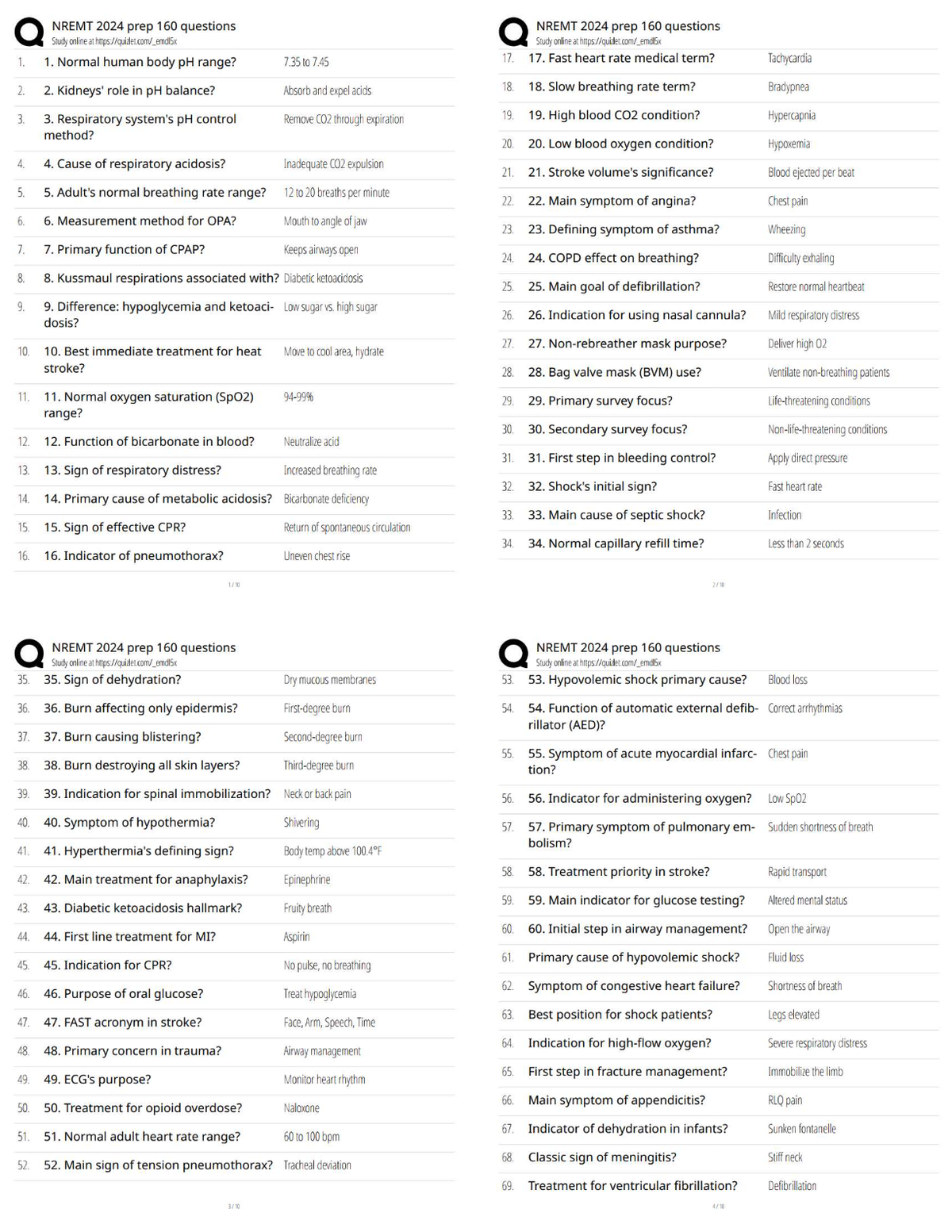
The National Registry of Emergency Medical Technicians (NREMT) EMT Cognitive Exam evaluates your baseline competence through a dynamic, computer-based framework. Passing this test requires mastering both medical theory and specific emergency response logic. [1]
📊 NREMT Exam Blueprint
The test tracks your abilities using a Computer Adaptive Test (CAT) mechanism. The system continuously recalibrates question difficulty based on your previous answers to accurately gauge your knowledge limits. [1, 2, 3]
- Question Volume: Ranging from 70 to 120 questions total.
- Time Allocation: Exactly 2 hours allowed.
- Scoring Threshold: Cutting off at 70 items signals absolute certainty of a decisive pass or fail.
- Core Concepts: Testing covers five key operational domains:
💡 High-Yield Test Strategies
- Prioritize Safety First: On the scene, personal, crew, and bystander safety always dictating the first move.
- Follow the ABC Pipeline: Address critical system failures in strict order: Airway, then Breathing, followed by Circulation.
- Spot Red Herring Answers: Eliminate options using treatments outside a basic EMT’s legal scope of practice.
- Differentiate Signs from Symptoms: Treat objective clinical signs separately from subjective patient complaints. [1, 2]
📝 Sample Diagnostic Questions
Question 1
A 65-year-old male presents with crushing central chest pain, diaphoresis, and nausea. He has a history of angina and is prescribed nitroglycerin. His blood pressure is 88/54 mmHg. What is your immediate next action?
- A) Administer one dose of prescribed nitroglycerin.
- B) Place the patient in a prone position.
- C) Administer supplemental oxygen and prepare for immediate transport.
- D) Assist the patient with his prescribed metoprolol.
Correct Answer: C
- Why it is correct: Nitroglycerin is a potent vasodilator and is strictly contraindicated if systolic blood pressure falls below 100 mmHg. Immediate transport alongside oxygenation is the correct protocol.
- Why others are incorrect: Option A induces severe hypotension. Option B restricts vital respiratory efforts. Option D is outside standard basic EMT field protocols.
Question 2
You arrive at a motor vehicle accident where a vehicle has struck a utility pole. Downed power lines are draped across the hood of the vehicle. The driver appears conscious but dazed. What is your priority action?
- A) Approach the vehicle carefully from the rear.
- B) Signal the patient to exit the vehicle immediately.
- C) Instruct the patient to remain still inside the vehicle and clear the area.
- D) Move the power lines using a wooden broom handle.
Correct Answer: C
- Why it is correct: Scene safety takes absolute priority. The vehicle interior shields the occupant; exiting creates a dangerous ground-gradient discharge path.
- Why others are incorrect: Options A and B invite fatal electrocution hazards. Option D introduces severe, unauthorized risks with high-voltage lines. [1]
🛠 Recommended Study Resources
- Online Simulators: Practice with 40-question modules on the NREMT Practice Test Portal or experience realistic time constraints via the EMT National Training Simulator.
- Mobile Apps: Train on your phone using specialized tools like Limmer Education Apps or the EMT Exam Prep For Dummies App.
- Textbooks: Use comprehensive print tools such as the Amazon NREMT Study Guide featuring substantial question pools and detailed diagnostic feedback. [1, 2, 3, 4, 5]
Updated: Tue, 12 May 2026 00:34:18 +0300