
Solutions Manual For Microbiology An Introduction 13e (Global Edition) By Gerard Tortora, Berdell Funke, Christine Case
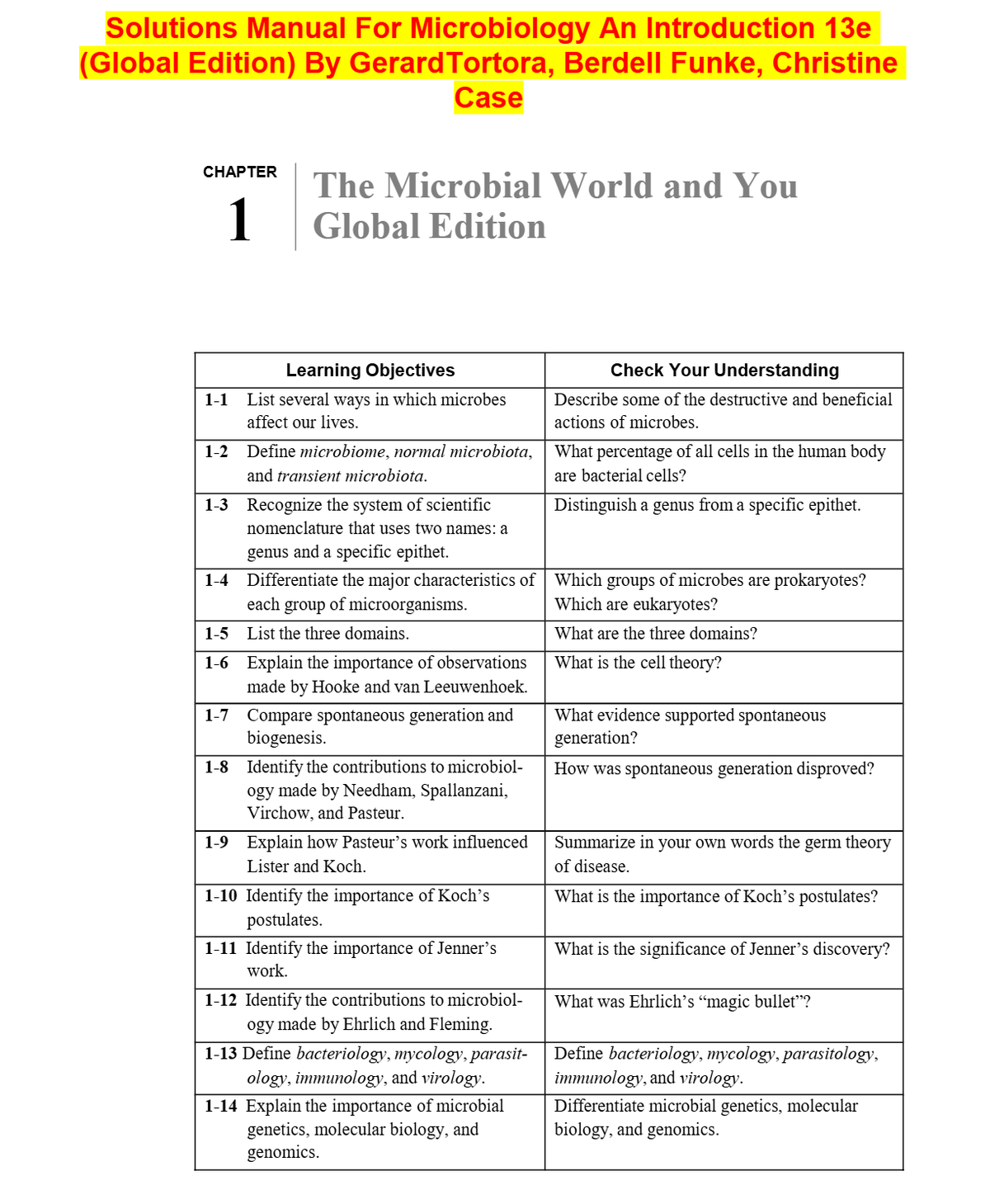
Solutions Manual For Microbiology An Introduction 13e (Global Edition) By Gerard Tortora, Berdell Funke, Christine Case-1. In a nomenclature system designed by Carolus Linnaeus (1735), each living organism is assigned tSolutions Manual For Microbiology An Introduction 13e (Global Edition) By Gerard Tortora, Berdell Funke, Christine Case-1. In a nomenclature system designed by Carolus Linnaeus (1735), each living organism is assigned two names. 2. The two names consist of a genus and a specific epithet, both of which are underlined or italicized. Types of Microorganisms (pp. 30–32) 3. Bacteria are unicellular organisms. Because they have no nucleus, the cells are described as prokaryotic. 4. Most bacteria have a peptidoglycan cell wall; they divide by binary fission, and they may possess flagella. 5. Bacteria can use a wide range of chemicalsubstances for their nutrition. 6. Archaea consist of prokaryotic cells; they lack peptidoglycan in their cell walls. 7. Archaea include methanogens, extreme halophiles, and extreme thermophiles. 8. Fungi (mushrooms, molds, and yeasts) have eukaryotic cells (cells with a true nucleus). Most fungi are multicellular. 9. Fungi obtain nutrients by absorbing organic material from their environment. 10. Protozoa are unicellular eukaryotes. 11. Protozoa obtain nourishment by absorption or ingestion through specialized structures. 12. Algae are unicellular or multicellular eukaryotes that obtain nourishment by photosynthesis. 13. Algae produce oxygen and carbohydrates that are used by other organisms. 14. Viruses are noncellular entities that are parasites of cells. 15. Viruses consist of a nucleic acid core (DNA or RNA) surrounded by a protein coat. An envelope may surround the coat. 16. The princi