
WGU D774 Intro to Business Accounting – Guaranteed Success Study Guide with Verified Questions and Answers
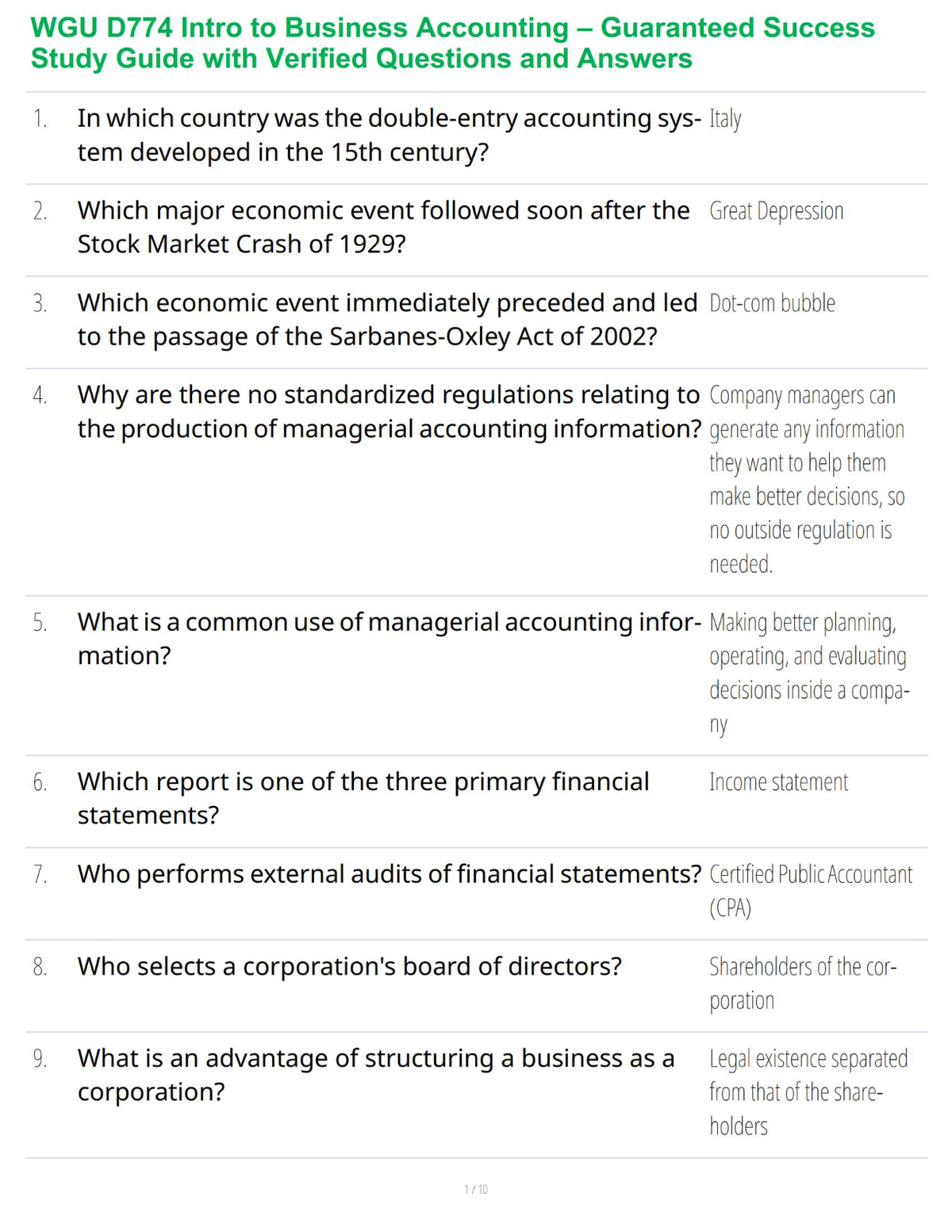
For the 2026 academic term, the WGU D774 Introduction to Business Accounting course focuses on foundational financial and managerial accounting principles. Students are evaluated on their ability to distinguish between accounting reports for internal and external users, understand financial statement structures, and apply basic budgeting methods. Core Course Concepts (2026 Updates)
- Financial vs. Managerial Accounting: Financial accounting provides standardized reports for external users (investors, creditors) based on past performance. Managerial accounting is tailored for internal decision-makers (management) and focuses on future-oriented data like budgets and forecasts.
- Essential Financial Statements: Students must know the content and sequential order of the four primary statements:
- Income Statement: Reports revenues and expenses over a period.
- Statement of Owner’s Equity: Tracks changes in retained earnings.
- Balance Sheet: A snapshot of assets, liabilities, and equity at a specific date.
- Statement of Cash Flows: Details cash from operating, investing, and financing activities.
- Accounting Formulas:
- Accounting Equation:
Assets = Liabilities + Equity. - Net Income:
Revenue - Expenses. - Contribution Margin:
Sales - Variable Costs.
- Accounting Equation:
- Costing and Budgeting: Understanding the difference between Product Costs (direct labor, materials) and Period Costs (administrative expenses) is critical. Budgeting methods covered include Zero-Based (starting from zero and justifying every cost) and Incremental (basing the new budget on the previous period).
Verified Exam Topics & QuestionsVerified 2026 study resources highlight several specific areas frequently appearing on the Objective Assessment (OA):
- Regulatory History: Knowledge of the Sarbanes-Oxley Act of 2002 (passed following the dot-com bubble) and its impact on increasing corporate responsibility.
- Roles of Organizations: The FASB establishes GAAP standards, while the SEC enforces these rules and requires reports like the Form 10-K (annual audited statements).
- Internal Controls: The purpose and necessity of internal controls to prevent fraud and ensure data accuracy.
- Variance Analysis: Identifying whether differences between actual and budgeted performance are favorable or unfavorable.
Recommended Study Resources
- Practice Assessments: Use the WGU D774 Pre-Assessment (PA) to identify knowledge gaps before the final exam.
- Video Supplements: Many students successfully use Tony Bell’s "Complete Financial Accounting Course" on YouTube (specifically the first 35 minutes) to clarify complex concepts.