
WGU History of Healthcare in America D050 – A+ Guaranteed Success with Verified Questions and Answers
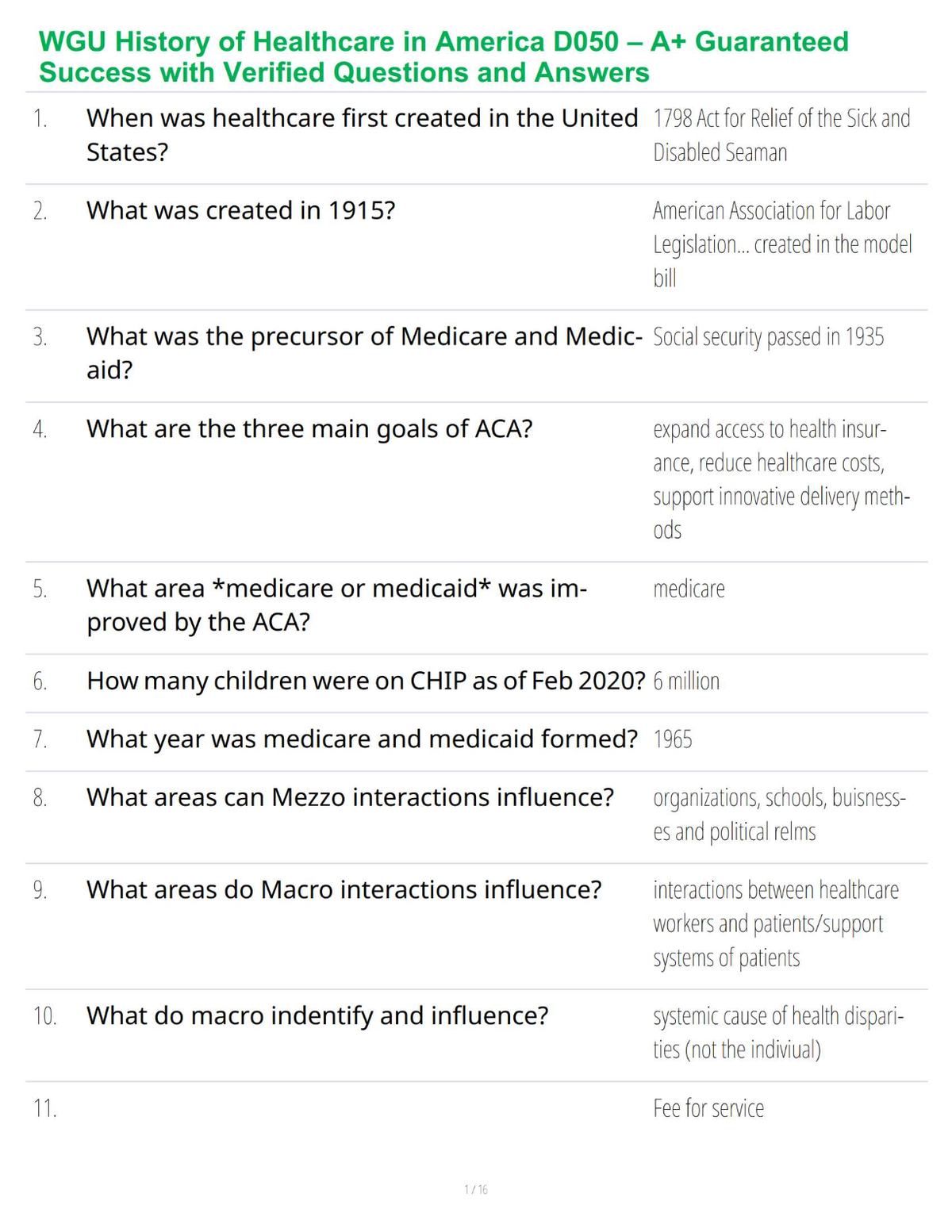
WGU D050, History of Healthcare in America, covers the evolution of the U.S. healthcare system, focusing on legislative milestones, payment models, and the intersection of social, legal, and economic factors. Key Historical Milestones
- Early Healthcare (1798): The Act for Relief of the Sick and Disabled Seamen required privately employed sailors to purchase health insurance, marking a very early federal foray into healthcare.
- Social Security Act (1935): Served as the legislative precursor to both Medicare and Medicaid.
- Medicare & Medicaid (1965): Formally established to provide coverage for the elderly and low-income individuals, initially using a fee-for-service (FFS) reimbursement model.
- HIPAA (1996): Established the Privacy Rule (patient access and disclosure control) and the Security Rule (standardizing security for PHI).
- Affordable Care Act (2010): Aimed to expand insurance access, reduce costs, and support innovative delivery methods like value-based care.
Models of InteractionThe course categorizes healthcare influences into three levels:
- Micro: Focuses on clinical practice and individual interactions between healthcare workers and patients.
- Mezzo: Influences organizations, schools, businesses, and community practices.
- Macro: Focuses on broad policies and the systemic causes of health disparities.
Payment & Delivery Models
- Fee-for-Service (FFS): Rewards providers based on the volume of services; while it offers flexibility, it can discourage efficiency.
- Value-Based Care: Pays providers based on patient outcomes. Key components include the 30-day rule, where readmissions within 30 days for the same diagnosis result in reduced payments.
- Medical Home: A philosophy within value-based care that integrates primary, specialty, and acute care into a patient-centered, coordinated approach.