
WGU Introduction to Cryptography – A+ Guaranteed Success with Verified Questions and Answers
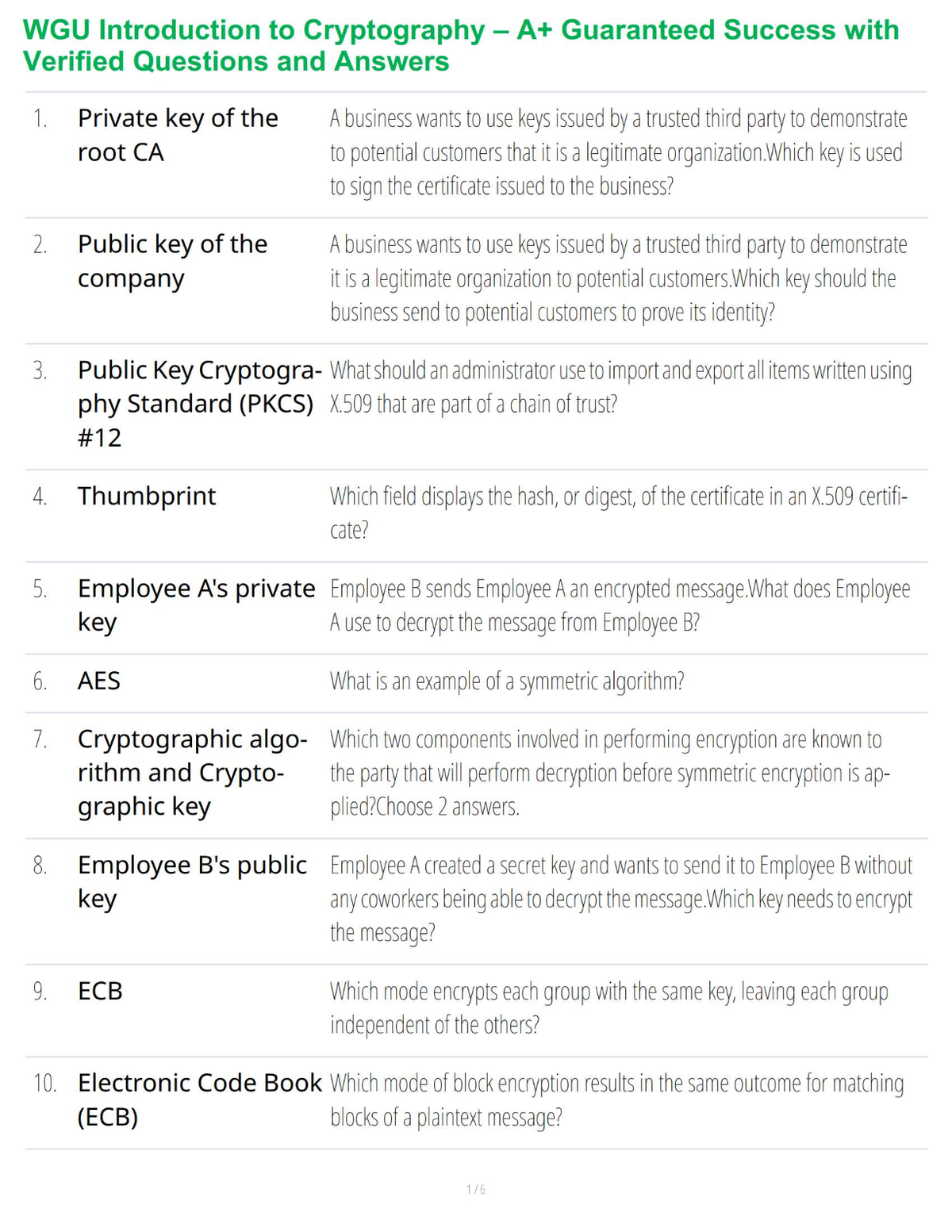
WGU's Introduction to Cryptography (C839 or D334) focuses on foundational cryptographic principles, algorithm mechanics, and public key infrastructure (PKI). Success in 2026 relies on memorizing specific algorithm details and understanding the practical application of encryption protocols.
Core Exam Topics to Master
- Symmetric vs. Asymmetric Algorithms: Memorize key and block sizes for major algorithms like AES (128-bit block), 3DES (64-bit block, 112/168-bit key), and RC4 (stream cipher).
- Block Cipher Modes: Understand the operation of Electronic Code Book (ECB), Cipher Block Chaining (CBC), and Counter Mode (CTR).
- Public Key Infrastructure (PKI): This is a heavily weighted section. Study the roles of the Certificate Authority (CA), Registration Authority (RA), and Certificate Revocation Lists (CRL).
- Hashing and Attacks: Know the hash sizes for MD5 (128-bit) and SHA-1 (160-bit), and identify attack types such as Rainbow Table, Birthday, and Dictionary attacks.
- Historical Ciphers: Be able to identify and explain Caesar, Playfair (5x5 matrix), and Vigenere ciphers.
Recommended Study Resources
- Shawn's Study Guide: Highly recommended by students for its condensed PowerPoint format and associated "Testmoz" quizzes.
- Encryption Excel Sheet: Use the official "Super Updated" sheet found in the Course Chatter to drill algorithm specifications.
- VitalSource Courseware: Read the EC-Council Certified Encryption Specialist v2 text provided in the learning resources rather than just the default course modules.
- Quizlet Practice: Use verified 2026–2027 test banks for D334/C839 to familiarize yourself with the wording of Objective Assessment (OA) questions.
Success Strategies
- Whiteboard Brain Dump: Practice writing out a table of algorithms, key sizes, and block sizes until it is muscle memory. Recreate this table on your provided whiteboard at the start of the exam.
- Mnemonic Devices: Use aids like "23BRAIDS" for symmetric algorithms (2fish, 3DES, Blowfish, RC5, AES, IDEA, DES, Skipjack) to quickly categorize them during the test.
- Concept over Memorization: For PKI and asymmetric encryption steps, ensure you understand the "why" behind each process to handle variations in OA questions.